
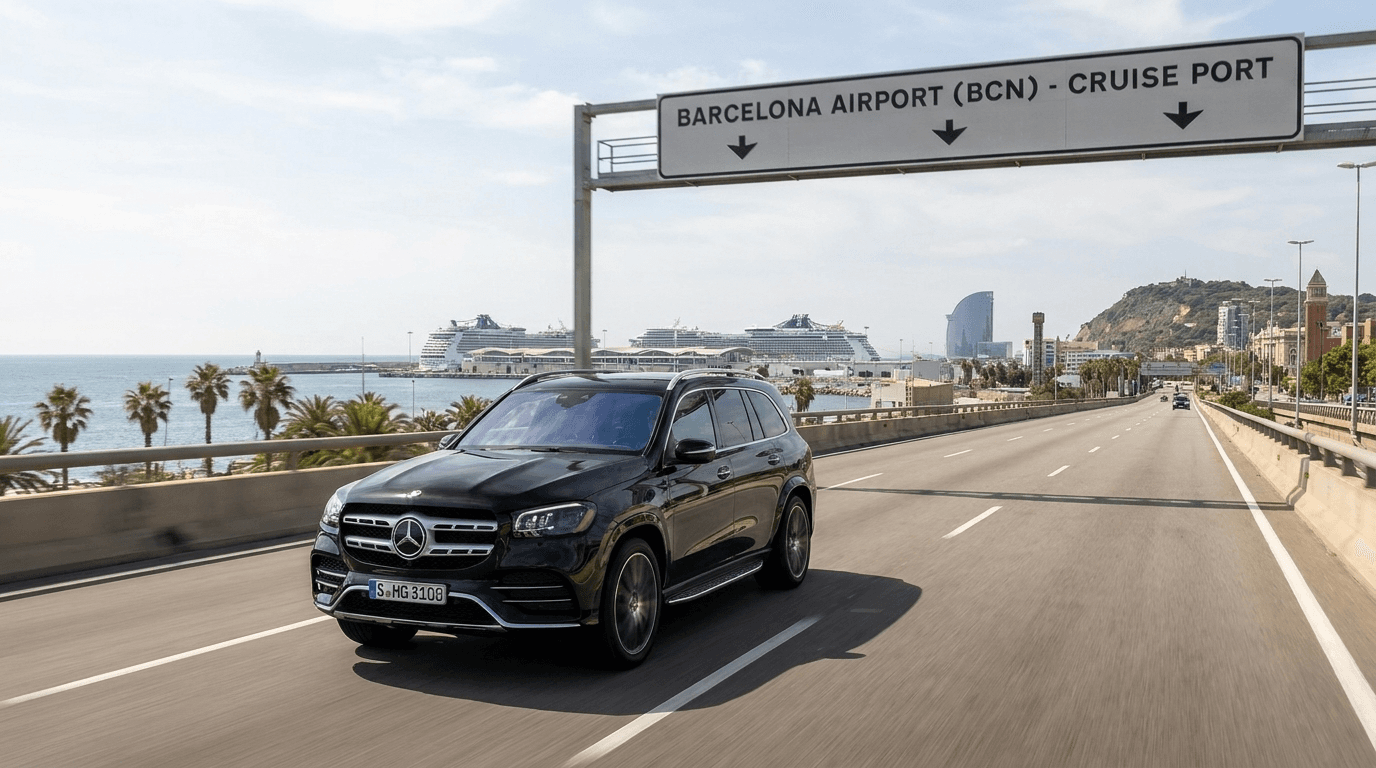
Barcelona airport to cruise port takes about 30 minutes by road, and the cheapest route takes more than an hour. The right choice depends on your luggage, your group size and how tight your embarkation window is. Barcelona also handles more cruise traffic than any other port in Europe, and the terminals sit farther out than the map suggests.
This guide compares every realistic way to cover the distance between El Prat Airport and the Moll Adossat terminals. You will find fares, timing, the metro route step by step, the terminal changes that affect 2026 and 2027 passengers and a few habits that keep embarkation day calm.
Your Options at a Glance
Three routes cover almost every traveler. A taxi runs straight to your terminal at a fixed fare. A private transfer does the same job with a driver who waits at arrivals and a price agreed in advance. Public transport costs the least, though it needs a metro line, a short walk and a shuttle bus.
Here is the practical difference. A taxi or private car carries you and your suitcases door to terminal with no changes. The metro route involves three separate legs, stairs and a walk with luggage. If you travel alone with a single bag and plenty of time, the metro makes sense. Families and anyone with large cruise suitcases usually prefer a car.
Distance and Travel Time
El Prat Airport lies southwest of the city, and the cruise terminals line a long pier at the southern end of the port. By road the trip covers roughly 15 to 20 km, depending on the terminal and the route. Drivers usually take the coastal ring road, then follow signs into the port area.
Official figures put the taxi ride at about 30 minutes without traffic. Expect more when the ring road is busy, especially on weekday mornings and Friday afternoons. Big embarkation days, when several ships sail at once, add pressure around the port gates. Plan your arrival at the terminal with a margin rather than a minimum.
Taking a Taxi to the Port
Taxis wait outside arrivals at both Terminal 1 and Terminal 2. Follow the signs to the rank and join the line. The ride to the Moll Adossat terminals carries an official fixed fare of 46 euros in each direction in 2026, with all surcharges included. Older guides quote lower numbers. Treat any figure published in earlier years with caution.
The fixed fare covers the vehicle, not each person. Two passengers pay 23 euros each and four pay 11.50 euros each, which makes a taxi cheaper than it first looks for a group. Tell the driver the exact terminal name or letter on your cruise documents, because the terminals sit far apart and a general request for the port can end at the wrong gate. Every terminal at Moll Adossat has its own taxi rank for the return trip.
Card payment is common, though a little cash helps if a reader fails. Ask for a receipt. Standard taxis seat four people, and large suitcases can push a group of four beyond what one car carries. Request a larger vehicle at the rank or book a van ahead of time.
Booking a Private Transfer
A car booked ahead removes the line at the taxi rank and the guesswork about fares. The driver tracks your flight, waits in the arrivals hall with a name sign and drops you at your assigned terminal. Vehicles range between standard sedans, minivans and minibuses, which lets large groups travel together instead of splitting across taxis.
A Barcelona cruise port transfer works well for these cases. Delayed flights are common on cruise days, and a driver who follows your landing time will not leave you stranded. Fixed fares also protect you against surprises with luggage or late hours. Give the booking your flight number, your terminal letter and the number of suitcases, because those details decide the vehicle size.
Private transfers suit families, travelers with mobility needs, anyone landing at night and groups of five or more. They also help when you land close to boarding time, because the driver knows the port gates and the shortest approach.
Metro and Cruise Bus, Step by Step
The metro route is the cheapest way, at about 9.40 euros per person, and it takes between 1 hour 15 minutes and 1 hour 30 minutes. No metro station sits at the port, therefore you combine the airport metro line, a transfer, a short walk and a shuttle bus.
-
Take the airport metro, line L9 Sud, at Terminal 1 or Terminal 2 and ride to Zona Universitària. The line runs about every 7 minutes and the ride takes around 30 minutes. The airport metro uses a special fare, and the usual T casual card does not work on it.
-
Change at Zona Universitària to line L3 toward Trinitat Nova.
-
Get off at Drassanes, at the lower end of La Rambla.
-
Walk a few minutes to Portal de la Pau, at the foot of the Columbus Monument.
-
Board the Cruise Bus to your terminal at Moll Adossat. A one way ticket costs 3.50 euros and a day ticket costs 5 euros. The bus accepts neither the T casual card nor other city passes, and the operator sells tickets online by card with a PDF sent to your email.
The metro route works best for light travelers. With a large suitcase, you face stairs and escalators at the interchange, and the Cruise Bus stop can be crowded before departure time. Buy the Cruise Bus ticket before you arrive at the stop.
Aerobús and Cruise Bus
The Aerobús sits between the taxi and the metro. Line A1 serves Terminal 1 and line A2 serves Terminal 2, and both run to Plaça Catalunya in about 35 minutes. Buses leave every 5 to 10 minutes during the day, and a one way ticket costs a little over 7 euros.
Plaça Catalunya sits about 6 km short of Moll Adossat. You can finish the trip by taxi, which costs around 16 to 20 euros depending on the hour, or ride metro line L3 between Catalunya and Drassanes and take the Cruise Bus. The Aerobús suits travelers who want a direct bus to the city and plan to spend time in the center before boarding.
Know Your Terminal Before You Leave the Airport
Barcelona has several cruise terminals, and your ship uses only one. Moll Adossat holds Terminals A, B, C, D, E and the MSC terminal, usually listed under the letter H. Terminal D is called Palacruceros, and Terminal E is called Helix. Terminals A and B sit about 2 km out of the city center, and Terminal C sits a little farther.
Two changes matter now. The World Trade Center terminals on the Moll de Barcelona, which sit closest to La Rambla, no longer take regular cruise traffic. The north terminal stopped in October 2023, and the south terminal is scheduled to close at the end of 2026. Terminal C is also scheduled for demolition around the same time, with a new Terminal G planned for 2027. If your cruise documents list an older address, confirm the current terminal with your cruise line before you travel.
Never tell a driver only that you are going to the port. Give the terminal letter or the ship name. Checking this one detail saves more time than any other tip in this guide.
Plan Around Your Flight
Cruise lines usually ask passengers to board in a window that opens several hours before departure. Your flight should land with a comfortable gap before that window closes. Many cruise passengers choose to arrive the day before and sleep in the city, which removes the risk of a delayed flight costing the ship.
If you land the same day, think in layers. Add time for passport control and baggage claim, then travel time to the port, then the check in process. Cruise terminals ask for passports and boarding documents, and queues grow when the departure hour nears. Keep both documents in your hand luggage.
Terminal 1 and Terminal 2 at the airport are two separate buildings, and a free shuttle bus links them every few minutes. Check which terminal your flight uses before you pick a rank or meeting point. A driver waiting at the wrong building can add 20 minutes to the start of the trip.
"Our flight landed late, and the driver was already waiting with our name on a sign. We reached the ship with an hour to spare."
Luggage Matters More Than Price
Most passengers underestimate cruise luggage. Two large suitcases and a carry on for each person will not fit in a small taxi. The port has no luggage storage, though a company named Bags&Go works with the port and moves bags between hotels, stations and the airport. If you plan to explore before boarding, ask about it.
Some airlines and cruise lines also run a joint check in service. Barcelona airport confirms that certain cruise passengers can check bags at the airport or at the cruise terminal, depending on the booking. Ask your cruise line if your fare includes it, because it changes how you travel.
Heavy bags are the main reason many travelers book a private van. Transpovia lists private rides in several vehicle sizes, which lets you match the car to your suitcases before you leave home.
Common Mistakes to Avoid
The first mistake is trusting an old address. Terminals have moved, closed and opened in recent years, and the World Trade Center area no longer works for most ships. The second mistake is assuming the metro reaches the pier. It does not, and the last leg needs a shuttle bus that runs on its own schedule.
The third mistake is leaving no margin. A late flight, a long passport queue and a slow ring road can stack up in one afternoon. The fourth mistake is carrying essential papers in a checked bag. Passports, boarding passes and any health forms belong in your hand luggage.
Going Back to the Airport
The return trip works in reverse. Each Moll Adossat terminal has a taxi rank at the entrance, and the same fixed fare applies to both airport terminals. When a ship docks, hundreds of passengers leave at once, and the taxi line can take time. A car booked ahead with a driver at the exit avoids that wait, and it works well when your flight leaves in the early afternoon.
Allow at least three hours between the time your ship docks and the time your flight takes off. Disembarkation can run late, and security at the airport adds time.
FAQs
How far is Barcelona airport to the cruise port by road?
The distance is roughly 15 to 20 km by road, depending on the terminal. A taxi usually takes about 30 minutes without heavy traffic.
How much is a taxi between Barcelona airport and the cruise port?
The official fixed fare in 2026 is 46 euros in each direction for the Moll Adossat terminals, with surcharges included. Fares can change, therefore check the current rate at the rank.
Is there a direct bus to the cruise terminals?
No direct public bus runs between the two. You can ride the Aerobús to Plaça Catalunya and continue by taxi or by metro and Cruise Bus.
Can I take the metro to the cruise port?
You can reach the area by metro, though no station sits at the port. You walk to Portal de la Pau and board the Cruise Bus to Moll Adossat.
Which terminal does my ship use?
Your cruise line confirms it in your boarding documents. Terminals A to E and the MSC terminal sit at Moll Adossat, and the World Trade Center terminals no longer serve regular cruise traffic.
How early should I arrive at the cruise terminal?
Follow the window your cruise line gives you. Many travelers arrive about two to three hours before departure, and landing the day before removes most of the risk.
Is Girona airport an option?
Some budget flights use Girona, which lies about 90 minutes north of the port. The route has no direct public service and a taxi ride is expensive. El Prat is usually easier.
Choose the Route That Fits Your Day
Take a taxi when you want the quickest path and travel in a small group. Take the metro and Cruise Bus when you travel light, have time and want to save money. Choose a private car when you carry heavy cruise luggage, land late or want a driver waiting at arrivals.
Whatever you pick, confirm your terminal before you leave the airport and keep your documents within reach. Transpovia can arrange a private ride between El Prat and your Barcelona cruise terminal in advance, and that keeps the last stretch of your trip relaxed.


