
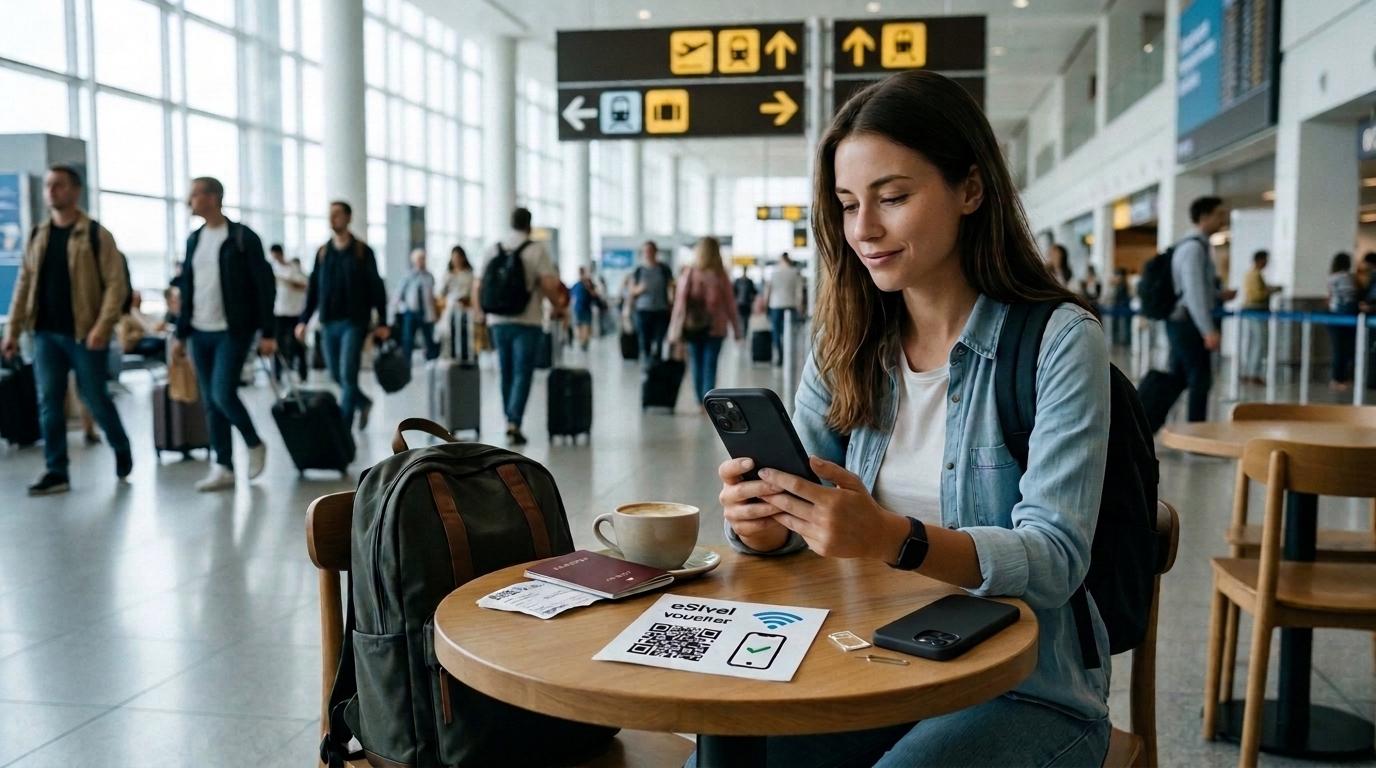
Are travel eSIMs worth it? For most trips that cross a border, yes. A travel eSIM usually costs less than roaming, installs in a few minutes, and gives you mobile data the moment you land. It does not win every time, though. Some trips work better with your home plan, a local SIM, or hotel wifi alone. This guide covers what you gain, what you give up, and what the costs really are, which helps you decide before you pay for a plan you did not need.
What a Travel eSIM Actually Does
An eSIM is a SIM card built into your phone in digital form. Instead of sliding a plastic card into a tray, you install a small profile, usually by scanning a QR code or tapping a link in an app. The profile tells your phone which network to join and how much data you bought.
A travel eSIM is a prepaid profile made for visitors. You choose a country, a region, or a global plan, pick a data amount and a number of days, and pay once. Your phone then connects to a partner network in the place you visit. You do not sign a contract, and nothing renews unless you choose a plan that does.
Two details matter right away. First, most travel eSIMs carry data only. They do not come with a local phone number or a voice allowance. Second, your normal SIM stays in the phone, and your home number keeps working for calls and text codes if you leave that line active. Most modern phones run both at once, with one line set for data and the other set for calls.
If you want to see how plans are structured before you read further, you can browse travel eSIM plans and check what a typical country or regional bundle includes.
The Real Pros of Travel eSIMs
You Can Sort Out Data Before You Leave
The biggest gain is timing. You buy and install the plan at home, on your own wifi, with no airport kiosk and no queue at a phone shop after a long flight. When your plane lands, your phone finds a network and you open your maps, your ride booking, and your messages without hunting for a signal.
That matters most on late arrivals. Landing at midnight in an unfamiliar city and needing a driver, a hotel code, or directions is the exact moment when having data pays off.
Costs Are Known Before You Travel
Roaming bills arrive weeks later and can surprise you. A travel eSIM works the other way around. You see the price, the data amount, and the validity period before you pay. When the data runs out, the line stops or you top up. No hidden overage shows up on a statement.
One Plan Can Cover Several Countries
If your trip touches three or four countries, buying a local SIM in each one wastes time and money. Regional plans for Europe, Southeast Asia, or Latin America can cover a whole route with one install. Coverage and speed vary by plan. Read the country list carefully before you buy.
Your Home Number Stays Active
Because the eSIM sits beside your regular SIM, you do not have to swap anything. Bank codes, delivery texts, and calls to your normal number can still reach you if your home plan allows it. Turn off data roaming on the home line to avoid accidental charges, and keep the line itself on.
Nothing Small to Lose
Physical SIM cards fall out of pockets, snap in cheap ejector pins, and vanish into airport trays. An eSIM cannot slip out in your bag. If someone steals your phone, they also cannot pull the card out and drop it in another device.
Hotspot Can Help a Group
Many plans let you share data with a laptop or a second phone. That helps couples and families who would otherwise buy several plans. Policies differ between providers, and some block sharing entirely. Check the terms before you count on it.
The Real Cons of Travel eSIMs
Your Phone Must Support It
Not every phone does. Recent iPhones and most higher priced Android models support eSIM, while older and cheaper devices often do not. Your phone also has to be carrier unlocked. If your home carrier locked the device, it may refuse any other network, and no travel plan will fix that. Check your settings for an option to add a cellular plan, or look up your exact model before you pay.
Most Plans Have No Phone Number
If you need to call a restaurant, a hotel front desk, or a driver who does not use messaging apps, a data only plan can be limiting. Calls over WhatsApp or similar apps work well when both sides use them. Plain voice calls to a local landline will cost extra or fail, depending on your home plan and the plan you bought.
A Local SIM Is Sometimes Cheaper
This is the honest weak point. In some countries a local prepaid SIM offers far more data for far less money, especially for stays of several weeks. A travel eSIM sells convenience, and convenience carries a markup in some places. The longer you stay in one country, the stronger the case for a local line.
Plans Expire and Have Rules
Travel eSIMs come with a fixed validity period. Some start the clock when you install, and others start when the phone first connects. Read that rule carefully. If you install a week early on a plan that starts counting at installation, you lose days you paid for. Unlimited plans often include a fair use limit that slows speeds after heavy use.
Setup Can Fail for Small Reasons
QR codes usually work only once. If you delete the profile by accident, you may need a new one. Switching phones in the middle of a trip can also cause trouble. Take a screenshot of your setup details and keep your confirmation email handy.
Coverage Depends on the Partner Network
An eSIM is not stronger or weaker than a physical SIM. Signal depends on the network the provider partners with in that country. In big cities this rarely causes trouble. In rural areas, on islands, or in mountain regions, a local carrier with its own SIM can reach places a partner network does not.
What a Travel eSIM Costs and How to Judge Price
Prices change by country, data amount, and validity, and a single number would mislead you. Judge any plan with four checks.
First, look at the cost per day of use rather than the headline price. A small plan for three days and a large plan for thirty days are not the same product. Second, compare the data amount with how you actually use your phone. Maps, messaging, and ride booking use little. Video calls, streaming, and working on a laptop use a lot. Third, check the validity rule and ask if you can top up in the middle of the trip. Fourth, confirm hotspot support if you plan to share the connection.
Then compare the total with your alternatives. Your carrier may sell a daily international pass. Add up the number of days you will actually need and multiply. Daily passes feel cheap on day one and expensive by day ten. A local SIM may look cheaper on paper, though you should count the time spent buying it, the markup at an airport kiosk if you buy there, and any registration your destination requires.
A good rule is simple. For trips up to about two weeks, a travel eSIM tends to be the easiest and often the cheapest choice outside your home region. For long stays in one country, price a local plan before you commit.
Mistakes That Waste Money
Most regret traces back to a short list of errors. People buy a plan that covers the wrong country, since regional bundles list their countries and the list is easy to skim. They pick unlimited data for a trip that needs only maps and messages. They install the profile on a phone they later replace. They leave the home line on with data roaming enabled, and a surprise charge arrives anyway. And they forget that a plan with a start date can expire while the suitcase is still unpacked.
A two minute check on the plan page prevents every one of these. Read the country list, the validity rule, and the hotspot terms, and match the data amount to your real habits.
Travel eSIM vs Roaming vs Local SIM vs Hotel Wifi
Versus Your Home Carrier's Roaming
Roaming wins on pure ease, since nothing needs to be installed. It loses on price in many cases, especially for trips outside regions with free roaming agreements. Inside the European Union, residents generally pay their normal home rates, which means an eSIM adds little there. Outside that zone, compare the daily pass price with a prepaid plan before you decide.
Versus a Local SIM
A local SIM can give you a local number and strong value on long stays. It also means finding a shop, showing a passport in some countries, and swapping the card in your phone, which can cut off your home number if your device has only one tray. Choose a local SIM when you need a real local number or plan to stay a month or more.
Versus Relying on Hotel Wifi
Hotel wifi costs nothing extra, and it works in the lobby. Outside the lobby you have no maps, no ride booking, and no way to reach anyone. Public wifi in airports and cafes also carries security risks, and banking on it is unwise. For anything beyond a short city break, mobile data is a safety tool and not only a convenience.
Versus Portable Wifi Devices
A pocket router can serve a group, though it needs charging, a rental or purchase, and a trip to return it. A travel eSIM with hotspot support does much of the same job without another device to carry.
Who Should Buy a Travel eSIM and Who Should Skip It
Buy one if you travel abroad outside your home region, arrive late at night, visit several countries, work online while away, or simply want data waiting when you land. First time visitors who feel nervous about navigating a new city benefit most, because working maps and a messaging app remove a lot of stress.
Skip one if your phone does not support eSIM, if your home plan already covers your destination at no extra cost, if you will live in one country for months, or if you rarely use mobile data and will happily stay on hotel wifi.
"I landed at midnight, opened my maps, and my driver's message was already waiting. That alone made the plan worth it."
How to Set Up a Travel eSIM Without Trouble
A few habits prevent almost every problem.
Check compatibility and carrier lock status at least a few days before you travel. Buy the plan through a provider that lists your exact countries and states the validity rule clearly. Install it on a stable internet connection, ideally at home, and give the new line a clear name in your settings to avoid confusion with your main number.
Before you board, keep your home line on for calls and texts, choose the travel line for mobile data, and switch data roaming off on the home line. At your destination, turn on data roaming for the travel line, because the eSIM needs it to attach to the partner network. If you see no signal, restart the phone and check that the correct line is selected for data.
If you booked a ground transfer, save the confirmation where you can open it without data. Your driver or booking platform may need to reach you by message, and a working connection at arrivals makes the pickup much smoother.
FAQs
Is a travel eSIM worth it for a short trip?
Usually yes, especially outside your home region. Even a three day trip gains a lot with data that works on arrival, and a small plan often costs less than a daily roaming pass. If your home carrier includes your destination at no extra charge, you can skip it.
Can I keep my regular number while using a travel eSIM?
Yes, on most modern phones. Your regular SIM stays active for calls and texts while the travel eSIM handles data. Turn off data roaming on your home line to avoid extra charges.
Do travel eSIMs work for calls and texts?
Most are data only. You can call and message through apps that use the internet, and your home number still receives standard texts if that line stays on. A few providers sell plans with a local number, which usually cost more.
What happens if my phone does not support eSIM?
You cannot install a travel eSIM on it. A local physical SIM, a pocket wifi device, or your carrier's roaming pass will be your options. Check your phone settings for a cellular plan or eSIM option before you buy anything.
Is a local SIM cheaper than a travel eSIM?
Sometimes, particularly on long stays. For trips of about two weeks or less, the time saved and the lack of paperwork often favor the eSIM. For a month or more in one country, compare a local plan before you pay.
Can I use a travel eSIM for hotspot sharing?
Often yes, though not always. Hotspot rules depend on the provider and the plan. Read the terms before you buy if you plan to work on a laptop.
Conclusion
Travel eSIMs are worth it for most international trips because they remove the two biggest headaches, surprise roaming bills and the hunt for a SIM after landing. They are not a magic answer. Check that your phone supports eSIM, read the validity and hotspot rules, and price a local SIM if you plan to stay long in one place.
When you plan the rest of your arrival, think about the ride too. Transpovia is a ground transportation marketplace where you can book airport transfers and private rides ahead of time, which pairs well with a phone that connects the moment you step off the plane.


