
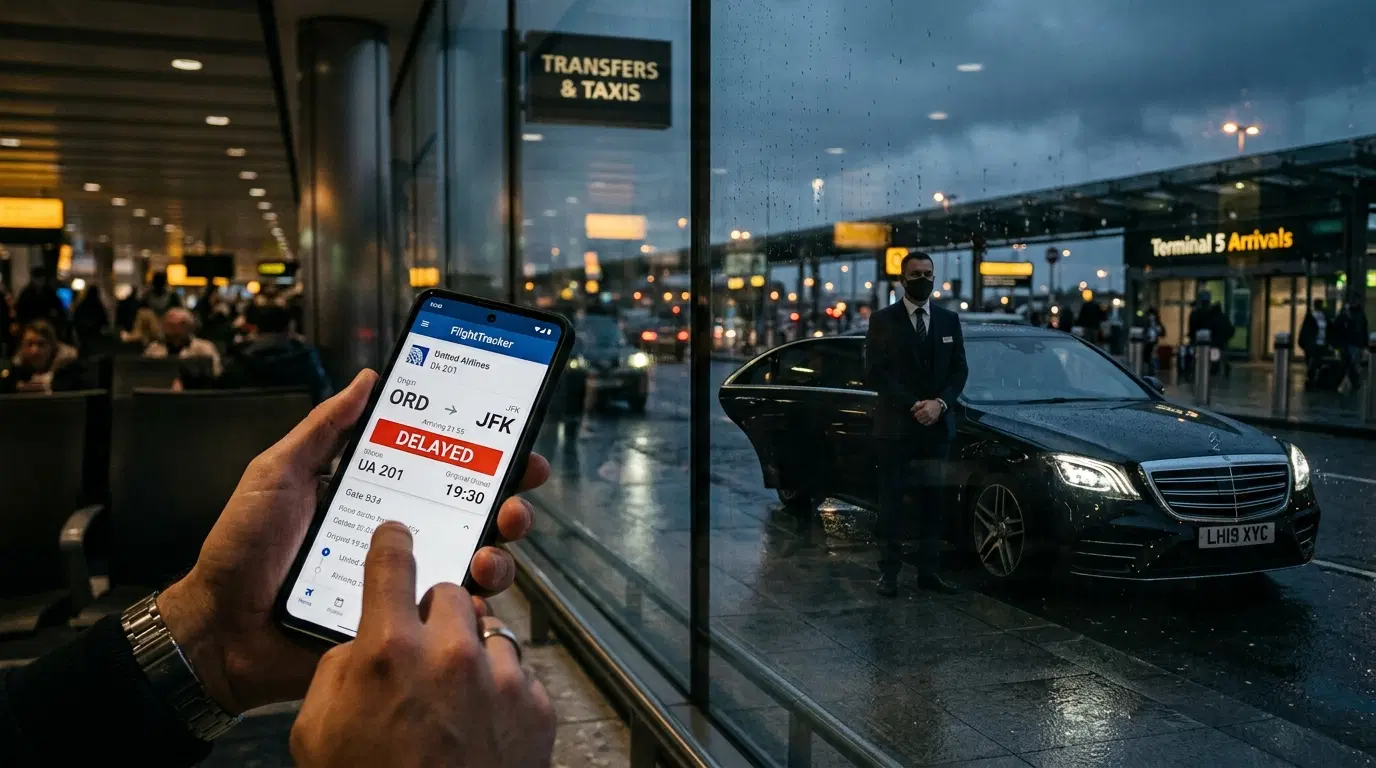
A gate agent announces a two-hour delay just as boarding was supposed to start, and suddenly the carefully planned pickup time no longer matches the actual landing time. For anyone who has pre-booked ground transportation, that moment raises an obvious question: does the driver still show up, or does the whole arrangement fall apart? Understanding how an airport transfer flight delay is actually handled — before it happens, not while standing at the gate — turns a stressful moment into a minor inconvenience.
Why Flight Delays Complicate Ground Transportation
A taxi or rideshare doesn't know or care what your flight number is. Neither service is watching your flight status, so a delay simply means a longer wait once you're ready to request a ride. A pre-booked private transfer works differently: a specific driver and vehicle are scheduled around your original arrival time, which means a delay actually changes the plan rather than just extending a wait.
Flight delays are common enough that any transfer plan needs to account for them. According to the U.S. Department of Transportation's Bureau of Transportation Statistics, the full-year flight cancellation rate across U.S. airlines was 1.4% in 2024, and that figure doesn't include flights that departed or arrived late but weren't canceled outright — a much larger share of total flights. Airlines can be affected by air traffic congestion at major hubs, weather, and seasonal surges during holidays and summer travel, all of which show up as delays rather than cancellations more often than not.
How Flight Tracking Actually Works
Most professional private transfer providers offer some form of flight tracking, which means the pickup time is tied to your flight's real arrival data rather than fixed to the original schedule. When you provide an accurate flight number at booking, the provider's system can follow that flight and adjust the driver's dispatch time as the estimated arrival changes.
This only works if the information behind it is correct. A wrong flight number, a missing airline code, or an itinerary where you're rebooked onto a different flight than the one originally provided can all cause the tracking to fail silently — the system keeps monitoring a flight you're no longer on. Reviewing this detail against your actual boarding pass, not just your original confirmation email, matters more than most travelers realize.
What Typically Happens After a Delay Is Detected
Once a delay shows up in the tracking data, the usual outcome is straightforward: the driver's arrival time is recalculated around your new estimated landing time, plus a standard allowance for baggage claim, immigration, and customs where applicable. You generally don't need to contact anyone for a routine delay of a few hours on the same day, provided the flight tracking is working correctly and the flight still lands at the originally booked airport.
Longer or more complex disruptions are different. A delay stretching into an overnight change, a diversion to another airport, or a rebooking onto a different flight number typically requires contacting the transfer provider directly, since automatic tracking may not carry over to a completely different flight or airport. Airport Pickup After a Delayed Flight generally still works the same way in principle — the pickup follows your actual arrival — but any change beyond a straightforward delay is worth confirming directly rather than assuming it updates on its own.
|
Situation |
What Usually Happens |
Action Needed |
|
Delay of a few hours, same flight, same airport |
Pickup time adjusts automatically with flight tracking |
Usually none, if flight details were accurate at booking |
|
Overnight delay or next-day arrival |
May require rebooking or a new pickup arrangement |
Contact the provider directly |
|
Rebooked onto a different flight number |
Tracking may not transfer automatically |
Update the new flight number with the provider |
|
Diverted to a different airport |
Original pickup point no longer applies |
Contact the provider immediately |
Why Some Delays Are More Predictable Than Others
Not all delays behave the same way, and understanding the difference helps set realistic expectations for how much notice a transfer provider actually has. Delays tied to air traffic congestion at major hub airports often build gradually over the course of a day, which means later flights on the same route tend to inherit earlier delays and the disruption is visible well before boarding. Weather-related delays can appear with more warning when a storm system is tracked in advance, but they can also cascade quickly once ground stops or gate holds begin at a busy airport.
Mechanical delays and last-minute schedule changes tend to surface with less advance notice, sometimes only becoming clear at the gate. This matters for ground transportation because flight-tracking systems can only respond to information that airlines have actually published. A delay that isn't yet reflected in official flight data won't show up in a transfer provider's tracking either, which is one more reason a direct message to the provider is worth sending the moment you personally learn about a significant delay, rather than assuming the system already knows.
Waiting Time After Landing
Even with accurate flight tracking, the moment a plane touches down isn't the moment you reach the curb. Immigration lines, baggage carousels, and customs checks all add time that varies by airport, time of day, and how many international flights land close together. Reputable transfer services build a reasonable grace period into the pickup plan that starts from the actual landing time rather than the original scheduled time, which covers this normal post-landing gap.
That grace period isn't unlimited, and policies differ by provider — some offer a set number of complimentary minutes with additional charges beyond that, while others handle it differently depending on whether the delay is a normal wait or an extended disruption. Confirming the specific waiting-time policy at the time of booking avoids confusion if baggage claim runs unusually long.
What You Should Do When a Delay Happens
Flight tracking handles most of the work automatically, but a few actions on your end reduce the chance of a mismatch:
-
Confirm the flight number in your booking matches your boarding pass, especially after any schedule change or rebooking.
-
If you're notified of a delay before departure, consider updating the transfer provider directly rather than assuming the tracking will pick it up in time.
-
Keep a working phone number active for the provider, and turn your phone back on as soon as it's permitted after landing.
-
If your flight is diverted or you're rebooked to arrive at a different airport, contact the provider as soon as possible, since the original pickup location and route no longer apply.
When a Delay Turns Into a Missed Connection
A delay that causes a missed connecting flight is a different situation than a straightforward late landing. In that case, your final arrival airport, flight number, and time may all change, sometimes to the following day. Because the ground transportation was booked around the original itinerary, treating this as a completely new arrival — rather than assuming the existing booking will simply shift — is the safer approach. Contacting the transfer provider with updated flight information as soon as the new itinerary is confirmed gives them the best chance to reassign a driver rather than leaving the original booking unfulfilled.
Does a Delay Change the Price?
For a transfer with fixed, pre-agreed pricing, a routine delay typically doesn't change the cost, since the rate was set based on the trip itself rather than the exact arrival time. This differs by provider, though, and delays extending into extra waiting time beyond a complimentary grace period may incur additional charges under some policies. A major disruption requiring a new booking altogether — a different day, airport, or itinerary — is more likely to involve a new charge or a change fee, depending on the provider's cancellation and rebooking terms.
Frequently Asked Questions
Do I need to tell my airport transfer company about a delay?
For flights with accurate flight-number tracking, usually not for a routine delay. It's still good practice to send a quick update if you're notified of the delay before departure, since that gives the provider more time to adjust.
What if my flight is delayed overnight?
This typically requires direct contact with the provider, since an overnight delay effectively creates a new arrival time and possibly a new date, which automatic flight tracking may not handle the same way as a same-day delay.
Does flight tracking work for connecting flights?
Flight tracking follows the specific flight number provided at booking. For a multi-leg trip, that should be the final flight that actually lands at the pickup airport, not the first flight of the itinerary.
Will I be charged extra if my flight is delayed?
For a standard delay within the provider's flight-tracking and grace-period policy, typically not. Extended waits beyond the complimentary period, or a delay significant enough to require a new booking, may involve additional charges depending on the provider.
Before You Leave
A delay doesn't have to derail ground transportation if the flight details on file are accurate and the provider's flight-tracking and waiting-time policies are clear before travel. Confirm the flight number matches your actual boarding pass, keep a way to reach the provider after landing, and treat anything beyond a routine delay — a diversion, an overnight change, a new flight number — as worth a direct call rather than an assumption.


