
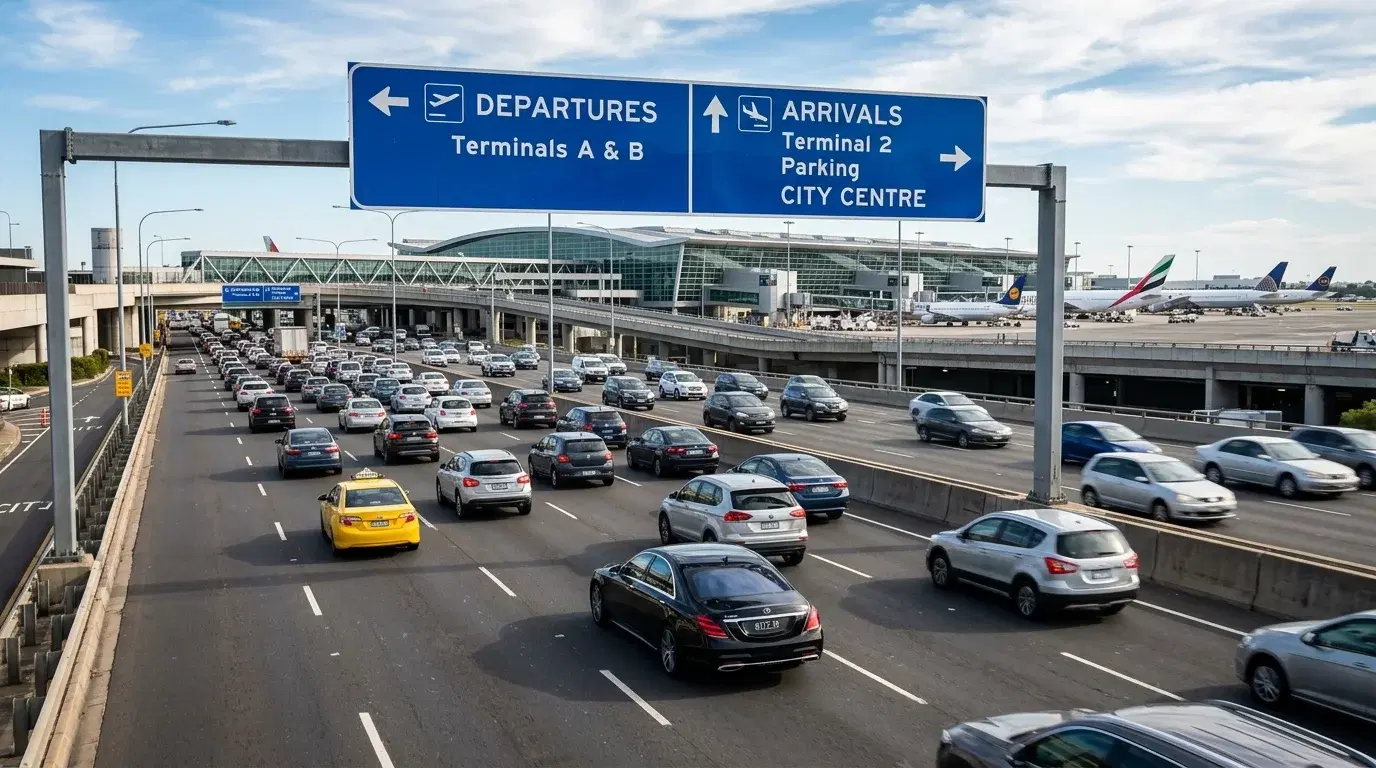
The security line gets all the worry, but the drive to the terminal is where more flights are actually lost. A route that takes 30 minutes at 10 a.m. can take 70 at 8 a.m., and that gap is enough to close a bag-drop counter in your face. These airport traffic travel tips help you time the drive around the predictable rush and holiday peaks, build the right buffer, and pick the arrival window that keeps a slow road from costing you the flight.
Know the Daily Rush Windows
The single most useful move is avoiding the two daily congestion peaks. Traffic to most airports is heaviest during the morning rush, roughly 6 to 9 a.m., and the evening rush, roughly 4 to 7 p.m. Those windows also overlap with the busiest airport security queues, so an early flight can hit you twice — a slow drive followed by a long line.
If your flight falls inside one of those windows, you don't get to skip the traffic, but you can plan for it. Treat your normal drive time as a floor, not an estimate, and add substantial padding. A trip that's quick on a quiet mid-morning can stretch 20 to 30 minutes longer once average speeds drop in a congestion zone.
The quietest roads, and the quietest checkpoints, tend to be mid-morning on a weekday — after the commuter rush clears and before the afternoon build-up. If you have any say over your flight time, an off-peak weekday departure is the easiest version of this whole problem.
For a broader look at reducing friction on the way in, this guide on How to Get to the Airport Without Stress pairs well with the timing advice here.
Watch the Weekly Pattern
Some days are simply worse than others, and the pattern is consistent enough to plan around. According to TSA checkpoint analysis running through early 2026, Sunday is the busiest day for air travel by a clear margin, followed by Friday. Tuesday and Wednesday carry the lightest loads.
That matters for both ends of your trip. A Friday-evening departure or a Sunday-afternoon return means heavier roads and fuller terminals, driven by the overlap of weekend leisure travelers and returning business flyers. If your schedule is flexible, a midweek departure sidesteps much of it.
For business travelers especially, the Monday-morning outbound and Friday-evening inbound are the two heaviest commuting-plus-flying windows of the week. Shifting a trip by even one day can change the entire experience of getting to the gate.
Plan Around Holiday Peaks
Holiday periods bend all the usual rules, and the roads often clog worse than the terminals. Major US holiday weekends see record road volumes — AAA projected more than 72 million travelers over the July 4th window in 2025, with the large majority driving rather than flying.
The reliable pattern is that the days around the holiday are worse than the holiday itself. The Thursday and Friday before, and the return Sunday, tend to be the heaviest, while the holiday date can be one of the lightest. A widely used rule for these stretches is to get out the door before late morning — leaving before about 11 a.m. beats the worst of the afternoon congestion curve on peak days.
Seasonal peaks work the same way. Late spring through midsummer and the year-end holidays all mean heavier roads to the airport. During these windows, add 30 minutes or more on top of whatever your normal buffer would be.
Build a Real Traffic Buffer
A buffer is only useful if it reflects the day you're actually traveling. On a normal off-peak trip, 20 to 30 minutes on top of your travel time is enough to absorb ordinary surprises. On a peak morning, during a holiday stretch, or in a city with notoriously unpredictable roads, that cushion needs to grow.
Stack extra time for each factor that applies rather than assuming they offset:
-
A departure inside the 6–9 a.m. or 4–7 p.m. rush
-
A Friday, Sunday, or holiday-weekend travel date
-
An unfamiliar route or a city known for congestion
-
Bad weather, which slows both the roads and airport operations
-
Any leg that depends on a single bridge, tunnel, or highway with no alternate
The habit that saves trips: check live traffic on your exact route during the window you plan to leave, not a typical-day estimate, and check it again shortly before you go. Have one backup route in mind for the days a main artery seizes up.
Match Your Transport to the Traffic
How you get to the airport changes how exposed you are to traffic — and how much of it you have to manage yourself. Each option trades off differently.
-
Driving yourself: Full control of timing, but you also absorb the parking hunt and the shuttle to the terminal, and you're the one navigating the congestion. Best when you know the route well and aren't traveling at a peak.
-
Public transport: Often immune to road traffic on rail lines, but tied to fixed schedules and first/last-service times. Check whether it runs early or late enough for your flight, and whether it handles your luggage comfortably.
-
Rideshare or taxi on demand: Flexible and door-to-door, but surge pricing and limited availability bite hardest during exactly the peak windows you're trying to survive.
-
Pre-booked private transfer: A fixed pickup time built around your flight removes the timing guesswork, which matters most for early departures, groups, or families with bulky luggage. A service like Transpovia sets that pickup in advance so a booked car is waiting rather than something you scramble to arrange in a rush window. The trade-off is committing to a time ahead versus the flexibility of deciding last-minute.
No option beats traffic entirely. The goal is choosing the one whose weaknesses don't line up with your specific travel day.
Departure vs. Return: Different Traffic, Different Plan
The trip out and the trip home aren't mirror images. On departure, you control your leave time, so the whole game is timing the drive around the rush. On the return, you land whenever your flight lands, and the traffic leaving the airport is out of your hands.
For arrivals, the friction is different: you clear the plane, collect bags, and reach ground transport during whatever congestion happens to be there. A pre-arranged pickup helps here too, since it means you're not joining a taxi queue or waiting on a rideshare during a post-flight crush. Plan the return leg as its own problem rather than assuming the outbound plan reverses cleanly.
FAQs
What is the best time to leave for the airport to avoid traffic?
Aim to travel outside the daily rush windows of roughly 6 to 9 a.m. and 4 to 7 p.m. Mid-morning on a weekday is usually the clearest for both roads and security. If your flight forces you into a peak window, add 30 minutes or more to your normal drive-time buffer and check live traffic before leaving.
Which days have the worst airport traffic?
Sunday and Friday are the busiest days for air travel, per TSA checkpoint data, while Tuesday and Wednesday are the lightest. Holiday weekends are heaviest on the days surrounding the holiday rather than the holiday itself. A midweek, non-holiday departure faces the least road and terminal congestion.
How much extra time should you add for traffic?
On a normal day, 20 to 30 minutes on top of your travel time covers most surprises. During rush hour, holidays, bad weather, or in a congestion-prone city, increase it. The safest approach is to check your specific route's live conditions during your planned departure window rather than relying on an average.
Does leaving very early actually help on holiday weekends?
Yes. On peak holiday travel days, congestion builds through late morning into the afternoon, so departing before about 11 a.m. avoids the worst of it. The days before and after a holiday are typically worse than the holiday date itself, so factor the exact date into your plan.
Before You Go
Time your drive around the rush: avoid 6–9 a.m. and 4–7 p.m. where you can, treat Sundays, Fridays, and holiday weekends as high-traffic, and check live conditions on your route before leaving. Size your buffer to the day, not the average. Booking a transfer with Transpovia locks in a pickup around your flight so traffic timing is one less thing to manage.
"The flight you lose to traffic is the one where you trusted the map's normal-day estimate on the worst travel morning of the year."


