
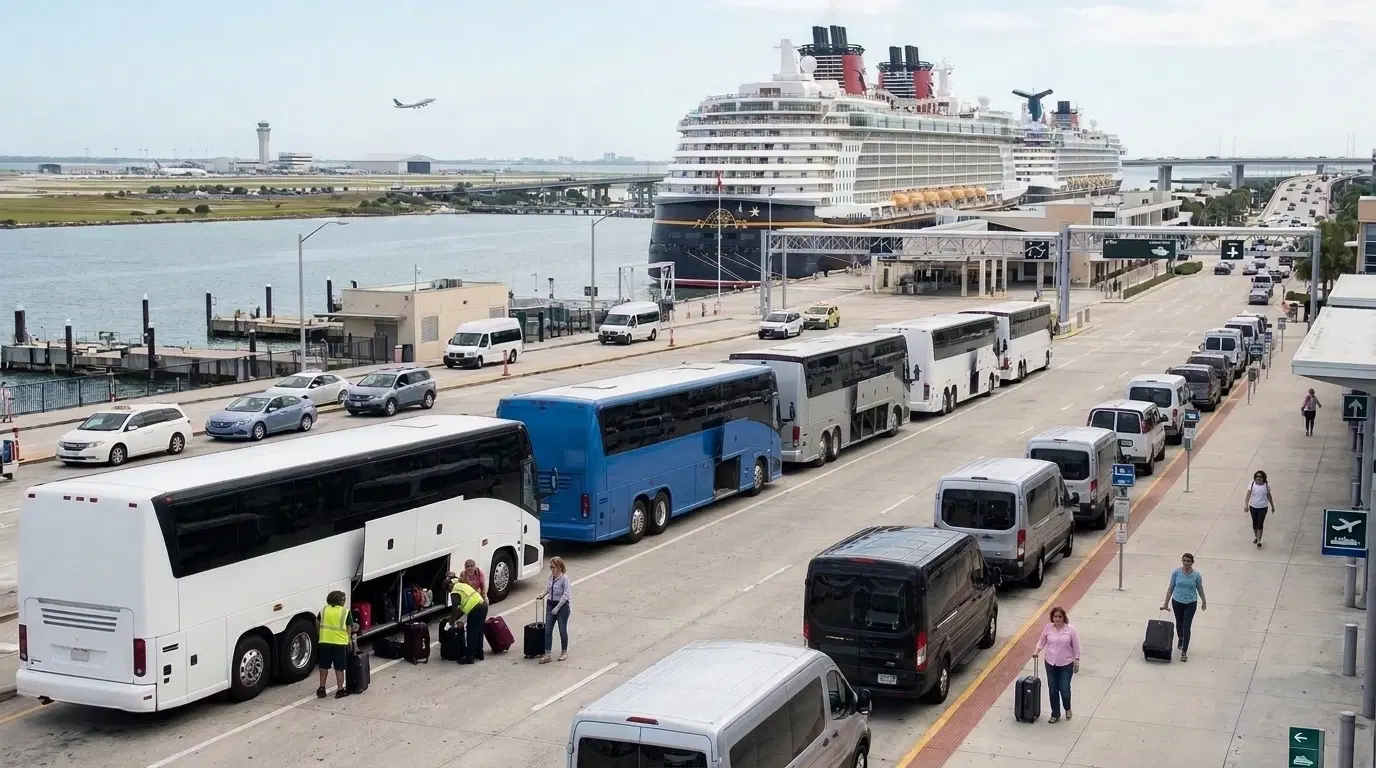
Your flight lands, your luggage is somewhere on a carousel, and a ship that will not wait is sitting at a pier across town. Airport to cruise port transportation is one of the most overlooked parts of a cruise vacation, and it can decide whether embarkation day feels smooth or stressful. The distance is rarely the problem. Timing, luggage, and unfamiliar logistics are what trip people up.
This guide walks through your realistic options, what each one costs you in time and flexibility, and how to choose the right one for your group.
Why Getting to the Port Deserves a Plan
Cruise lines assign check-in windows and set a final boarding cutoff, typically well before the ship sails. Check your cruise documents for your exact times, because they vary by line and port. Miss the cutoff and the ship leaves without you, which is why cruise lines and travel advisors routinely recommend flying in the day before.
Many travelers still fly in on embarkation morning, especially on short itineraries. If that is you, the transfer is not an afterthought. It is the final link in a chain that starts with your flight, and any delay upstream squeezes the time you have left.
Distance also varies more than people expect. Some airports sit very close to their cruise terminals, such as Fort Lauderdale-Hollywood International and Port Everglades, which are only a short drive apart. Others are far from the pier. Orlando International Airport to Port Canaveral is a drive of roughly an hour, depending on traffic. Check the actual route before you assume it is quick.
Airport to Cruise Port Transportation Options Compared
Most travelers choose from four options. Each works, but they work differently.
Cruise Line Shuttles
Many cruise lines sell transfer packages that run between the airport and the terminal. They are convenient to book alongside your cruise, and you ride with other passengers headed to the same ship. The tradeoff is the schedule. Shuttles often depart in waves tied to ship arrival times, so you may wait for other passengers or for a bus to fill. Pickup points can also be a walk from baggage claim.
Taxis and Rideshare
A taxi or rideshare can be fine for a couple with light luggage and a short ride. The weak spots are predictability and capacity. Availability can drop right when several flights land together, and fares in rideshare apps can rise with demand. Standard cars also fill up quickly with cruise luggage. Four people with four large suitcases and carry-ons rarely fit in a sedan.
Public Transportation
Trains, buses, and metro lines can reach some ports, and they are the cheapest choice. They are also the hardest with heavy bags, multiple transfers, and a boarding deadline. For most cruise passengers they are a backup plan, not a first choice.
Private Transfers
A private transfer means a driver and vehicle reserved just for your group, booked ahead of time. You choose the vehicle size, the price is confirmed when you book, and the driver tracks your flight rather than guessing when you will land. There is no waiting for a bus to fill and no stops for strangers. Of the four options, this one gives you the most control on a day when timing matters most.
What a Private Transfer Actually Does for You
The real advantage of a pre-booked car shows up in the small moments. A driver who knows your flight number can adjust when the plane is late. A vehicle matched to your party size means your luggage rides with you instead of in a second car. And you are dropped at the right terminal for your ship, which matters at ports with several cruise terminals.
Transpovia is built around this kind of arrangement. You book a private airport transfer in advance, choose a vehicle that fits your group, and know your ride is waiting before you leave home. If you are comparing options for cruise port transportation, it helps to look at the specific port you are sailing from, since terminal layouts and drop-off arrangements differ.
Private transfers also suit groups well. Split between four or five people, a private vehicle can compare reasonably with individual shuttle seats, and you get door-to-pier service in return. Families with strollers, car seats, or older relatives tend to value this most, because nobody has to manage transfers between buses.
How Much Time to Allow
Work backward from your ship, not forward from your flight. Start with the all-aboard time printed on your cruise documents, then subtract the drive, the time to collect checked luggage, and a buffer for customs or immigration if you are arriving internationally.
A few habits make this easier:
-
Choose a flight that lands well before your check-in window opens, ideally the day before if you can manage it.
-
Book your transfer for your actual arrival, and give the driver your flight number so they can monitor delays.
-
Keep your cruise documents, passport, and boarding information in your carry-on, not in your checked luggage.
-
Confirm which terminal your ship uses. Larger ports often have several, and the wrong drop-off can cost you time.
Travelers arriving on a morning flight often fare better than those on a mid-afternoon arrival, since there is more room for delays before the boarding cutoff.
Common Mistakes to Avoid
The most common error is booking a flight that arrives too close to departure. A single delay, whether weather, air traffic, or a late connection, can leave you with no recovery time. Cruise lines generally do not hold ships for passengers who arrive late on their own transport.
Another mistake is assuming you can sort out the ride on arrival. At busy ports, a large share of the same flights lands within the same few hours, and everyone is looking for a car at once. Reserving in advance takes that uncertainty out of the day.
Finally, travelers sometimes plan around luggage they only imagine. Cruise packing tends to run heavier than a standard trip, with formal wear, multiple outfits, and sometimes gear for excursions. Make sure the vehicle you choose actually fits your bags as well as your group.
Choosing the Right Option for Your Trip
For a solo traveler on a short hop with a single bag, a taxi or rideshare may be enough. For a couple with moderate luggage and flexible timing, a cruise line shuttle is a reasonable middle ground. For families, groups, first-time cruisers, and anyone on a tight schedule, a private transfer removes the most variables.
If you also plan to explore before or after your cruise, it is worth browsing the transportation destinations Transpovia covers, since the same booking approach works for hotel transfers and other airport rides on your trip.
Frequently Asked Questions
How early should I arrive at the cruise port?
Follow the check-in window printed on your cruise documents, and plan to be aboard before the final boarding cutoff. Arriving at the start of your assigned window usually means shorter lines at the terminal. Build in extra time for the drive from the airport, especially at ports that are an hour or more away.
Is a private transfer better than a cruise line shuttle?
It depends on what you value. A cruise line shuttle can be convenient and may cost less per person for solo travelers. A private transfer gives you a dedicated vehicle, no shared stops, and a pickup that adjusts to your flight, which many families and groups prefer. It is also easier to match to your luggage and party size.
Can I take a taxi or rideshare from the airport to the cruise terminal?
Yes, in most cases. The main concerns are availability during busy arrival periods, price changes in rideshare apps, and whether the car can hold your luggage. If you want certainty about the ride and the price, pre-booking a private transfer is the safer choice.
Conclusion
Getting from the airport to your ship is a short part of a cruise trip, but it sets the tone for everything that follows. Allow enough time, know which terminal you need, and think honestly about your luggage and group size. Shuttles and taxis can work in the right situations, but a pre-booked private transfer gives you the clearest plan on the day when there is the least room for error. Reserve your ride before you go, and you can spend your first hours on the ship, not worrying about getting there.
"Our flight landed a little late, but our driver was already there, and we were at the ship with time to spare. It made the whole day easier." — Daniel, traveling with his wife and two kids


