
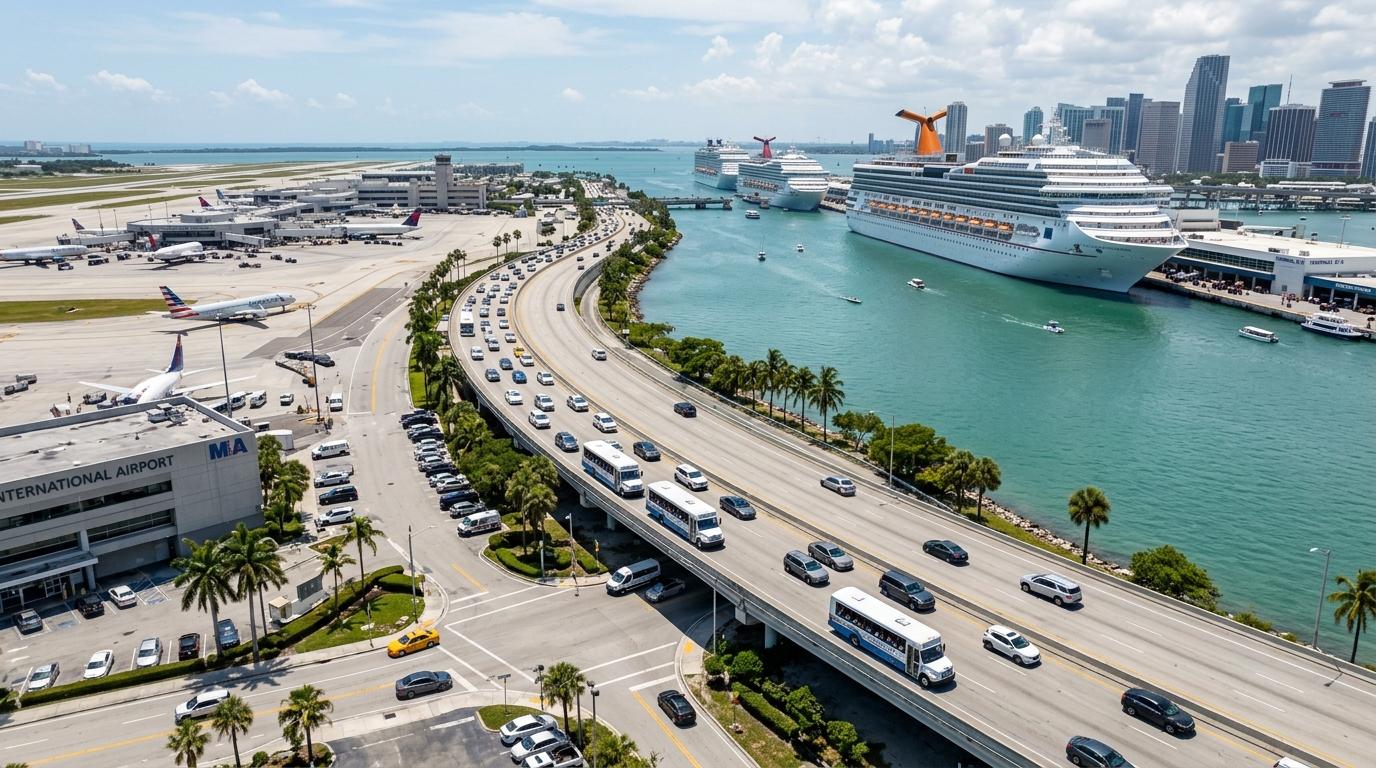
Missing a cruise ship's departure isn't like missing a flight — there's no next sailing to rebook onto an hour later, and the ship generally won't wait. That reality makes the trip from the airport to the cruise terminal one of the highest-stakes transfers in travel, especially for a first-time cruiser who doesn't yet know how tight the timing actually is. Planning an airport to cruise port transfer correctly, with realistic timing and a clear transportation plan, is what separates a relaxed embarkation day from a stressful dash to the pier.
Why This Transfer Carries More Risk Than a Typical Airport Trip
A cruise ship operates on a fixed departure schedule tied to port operations, and cruise lines are explicit about what happens to travelers who arrive too late. Royal Caribbean states that guests must be fully checked in and onboard no later than 90 minutes before port operations close, and travelers who miss that cutoff are not permitted to sail. Norwegian Cruise Line applies a similar rule, requiring guests to complete check-in and board no later than one hour before the ship's departure time, regardless of what caused the delay.
This is fundamentally different from an airport transfer to a hotel, where a late arrival simply means checking in later than planned. A missed cruise departure means missing the first day, or more, of an already-paid vacation, with no automatic path to catch up other than arranging separate, often expensive travel to the ship's next port of call.
How Much Time to Plan Between Landing and the Ship's Departure
Cruise lines and independent cruise resources consistently recommend flying into the departure city the day before the cruise rather than the same day, specifically because flight delays or cancellations on sailing day leave no buffer if something goes wrong. How Early Should You Arrive at the Airport covers general airport timing, but a cruise departure adds a layer that a typical flight connection doesn't: once the ship's boarding cutoff passes, there's no rebooking option the way there is with a missed flight.
For travelers who do fly in on embarkation day despite the risk, building in as much buffer as possible between the scheduled landing time and the ship's stated boarding deadline is essential, and treating the first available flight of the day as a safer choice than a later one reduces how much a delay could cost.
Choosing Between Ground Transportation Options
Several transportation types can cover the airport-to-port route, and each comes with different trade-offs for a first-time cruiser managing luggage and unfamiliar territory.
|
Option |
Timing Reliability |
Luggage Handling |
Best For |
|
Taxi |
Generally reliable but subject to traffic and queue wait |
Limited to trunk space |
Solo travelers, light luggage, daytime arrivals |
|
Rideshare app |
Reliable where the app operates locally; wait varies |
Limited to vehicle size |
Travelers comfortable navigating an unfamiliar app-based pickup zone |
|
Cruise line transfer |
Scheduled around typical flight arrivals, but on a fixed group schedule |
Often includes luggage assistance |
Travelers wanting one less logistics decision, less flexible on timing |
|
Pre-booked private transfer |
Fixed pickup tied to your specific flight, adjustable for delays |
Vehicle matched to group and luggage at booking |
Groups, families, and travelers wanting a direct, flight-tracked ride |
Cruise-line-organized transfers, purchased directly through the cruise line, typically run on a set schedule tied to a block of flights rather than an individual traveler's specific itinerary, which works well when arrival times align but offers less flexibility if a flight runs early or late. A private transfer booked separately, with flight tracking built in, adjusts to the traveler's actual landing time rather than a shared group schedule, which matters more for a delayed flight that would otherwise miss a scheduled cruise-line shuttle's departure window.
Understanding Port Check-In and Boarding Windows
Nearly every major cruise line now uses a scheduled check-in window, selected during the cruise line's own online check-in process before travel, rather than a first-come, first-served embarkation. Norwegian Cruise Line recommends completing online check-in at least four days before sailing to secure a preferred boarding time, and MSC Cruises notes that arriving before an assigned check-in slot opens may mean waiting outside the terminal, while arriving after the slot closes can result in denied boarding altogether.
For a first-time cruiser, this means the airport transfer needs to target not just "sometime before the ship leaves," but the specific check-in window assigned during pre-cruise registration. Completing that online check-in well in advance, and building the ground transportation plan around the resulting time slot, avoids arriving either too early to be let in or too late to check in smoothly.
What to Expect at the Cruise Terminal Itself
Cruise terminals differ from airports in ways that catch first-time cruisers off guard. Luggage is typically dropped with porters at a designated curb area before check-in, tagged for delivery directly to the cabin rather than carried aboard personally, which means keeping essential items — medication, travel documents, a change of clothes — in a carry-on bag rather than checked luggage. What Happens After Landing at an International Airport covers a related process for arriving international travelers, and similarly, cruise terminal check-in typically involves document verification, a boarding pass or QR code scan, and in some cases security screening before boarding, adding time beyond just reaching the terminal building.
Large ports with multiple terminals — Port Everglades in Fort Lauderdale, for example, operates eight separate cruise terminals — make confirming the specific terminal assigned to a booking especially important, since ground transportation needs the exact terminal number, not just the port name, to reach the correct building.
Planning the Return Trip From Port to Airport
The same timing pressure applies in reverse on disembarkation day, though the direction of risk flips: instead of missing a ship departure, the concern becomes missing a flight home after a delayed or slow disembarkation process. Cruise ships typically clear customs and begin releasing passengers in stages after docking, and this process can take longer than expected, particularly for the first international port of a multi-stop itinerary or during a busy disembarkation morning with multiple ships in port simultaneously.
Booking a same-day flight departing shortly after a ship's scheduled arrival carries real risk if disembarkation runs behind schedule. Building in several hours of buffer between the ship's expected dock time and a flight's departure — and avoiding same-day flights entirely when the itinerary allows for a flight the following day instead — reduces the chance of a rushed, stressful trip back to the airport. A pre-booked transfer for the return leg, scheduled with some flexibility around the ship's actual disembarkation time rather than a fixed early-morning pickup, helps absorb a slower-than-expected exit from the terminal.
Group and Family Considerations
Families and larger groups cruising together face additional coordination on the airport-to-port leg, particularly when flights land at different times or from different cities. A private transfer that can be scheduled around each flight, rather than a single shared shuttle time, accommodates staggered arrivals more easily. For groups traveling with strollers, multiple large suitcases, or family members who need extra time moving through an unfamiliar terminal, a vehicle sized appropriately for the whole group and luggage at once avoids splitting a family across multiple vehicles on an already time-sensitive day.
Frequently Asked Questions
Can a cruise ship wait if a flight is delayed?
Generally, no. Cruise lines operate on fixed departure schedules tied to port logistics, and most explicitly state that late arrivals will not be permitted to board once the check-in cutoff passes, regardless of the reason for the delay.
Is it safer to book a cruise line transfer or arrange private transportation?
Both work, but each fits different situations. A cruise-line-arranged transfer runs on a group schedule that may not adjust to an individual flight delay, while a pre-booked private transfer with flight tracking is built around the traveler's specific arrival time.
How early should online check-in be completed before a cruise?
Cruise lines generally recommend completing online check-in several days to weeks before sailing, since it determines the assigned arrival window and avoids a longer in-person check-in process at the terminal.
What happens if a first-time cruiser doesn't know which terminal to go to?
Checking the terminal number on the cruise documents or through the cruise line's app before arranging ground transportation avoids arriving at the wrong building, which is a common issue at ports with multiple terminals.
Before You Book
The airport-to-cruise-port transfer carries more real consequences than a typical airport trip, since a missed boarding cutoff usually can't be undone. Flying in a day early when possible, confirming the assigned check-in window, and choosing ground transportation that can adjust to an actual flight arrival time — rather than a fixed group schedule — gives embarkation day the buffer it actually needs.


